2025 was a great year for the stock market, and we see several indications that this strength can continue in 2026. Artificial Intelligence is driving increased productivity, capital investment, and earnings growth. Over $500 billion was spent on AI infrastructure in 2025 alone, with total investment expected to reach $5–8 trillion by 2030.
Looking back at last year, the markets briefly tumbled into bear market territory in April after President Donald Trump unveiled his tariff plans. These plans were eventually walked back to some extent, and the much-feared negative impacts of these tariffs on the economy proved to be minimal. Concerns over sticky inflation and overspending on A.I. infrastructure also failed to derail the market’s advance. In the end, most global stock markets finished the year near all-time highs.
Stimulative fiscal policy was critical in 2025 and may prove even more impactful in 2026. With midterm elections approaching, the administration has shifted focus towards affordability and economic support. Measures under consideration include cost-of-living adjustments to Social Security benefits—impacting approximately 75 million Americans—as well as potential direct payments to households. Defense spending is also increasing meaningfully, with planned outlays rising by roughly $500 billion by 2027.
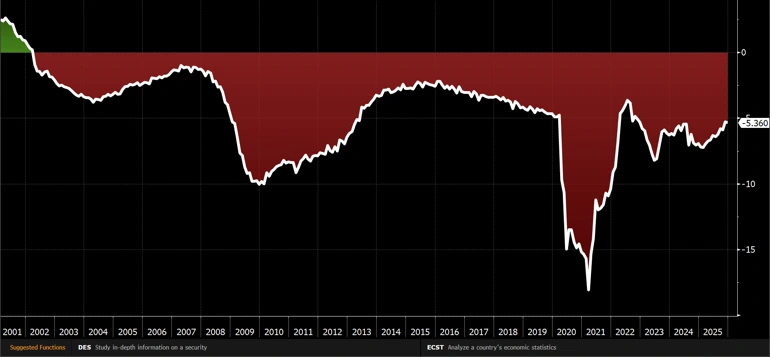
U.S. Budget Deficit (% of GDP)
Earnings Growth
Corporate earnings continue to be central, with projections for double-digit growth in both 2026 and 2027. While most of the earnings growth and stock market appreciation has been driven by the large technology/A.I. firms, we are encouraged by recent inflows into sectors like energy and materials. A.I. adoption is driving faster output growth while helping to contain labor costs, a combination that could be extremely positive for corporate earnings.
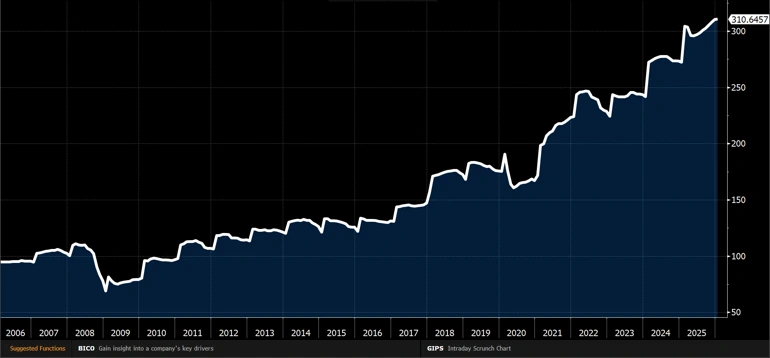
S&P 500 Index Forward Earnings per Share
Policy Support and the Labor Market
The U.S. economy is experiencing an AI-driven productivity increase. Notably, labor productivity growth is exceeding GDP growth—an unusual dynamic. Historically this has only been seen during recessions, but today it is occurring alongside economic expansion. This reflects an economy generating strong output with fewer workers, a dynamic that is highly supportive of corporate profits.
Markets are currently expecting two interest rate cuts in 2026. Large banks forecast the policy rate declining toward 3.25% in 2026, with potential for further easing depending on the Federal Reserve’s leadership and inflation trajectory.
The Federal Reserve will be closely watched by investors in 2026, as its Chair Jerome Powell will be replaced in May. Whoever is selected to be the new Fed Chair will almost certainly push for significantly lower interest rates. However, the Chair is only one of twelve voters, and we may see significant dissent within the Federal Reserve as this new chair looks to implement their dovish policy.
Market Broadening
Market leadership is gradually broadening beyond mega-cap technology. After years of U.S. equity outperformance, international markets are beginning to see inflows as valuation gaps narrow and fundamentals improve. Many institutional investors remain under-allocated internationally, suggesting further potential rebalancing.
That said, mega-cap technology remains the dominant factor driving market performance. The “Magnificent Eight” returned an average of over 26% in 2025 and accounted for nearly half of the S&P 500’s return. A.I. was the defining theme, and technology and communication services are expected to account for more than half of total earnings growth this year.
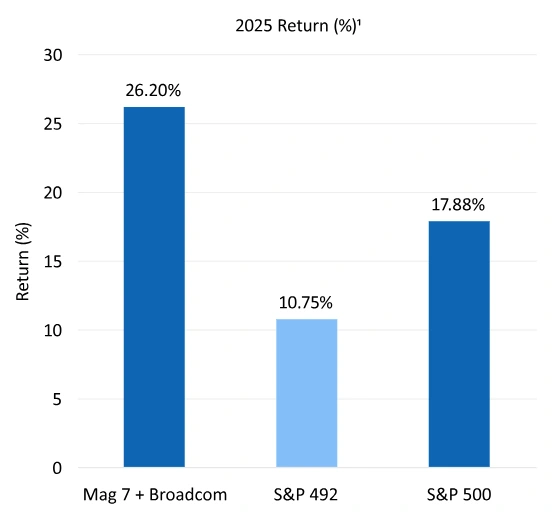
Opportunities outside U.S. equities are developing thanks to valuation discounts and strengthening fundamentals, although U.S. mega-cap technology stocks remain best-in-class from a cash flow and earnings perspective.
Currency Markets and International Exposure
Currency movements were a boon to international investments last year, as U.S. investors benefitted from a sharp depreciation in the Dollar against other currencies.
Back in April many pundits feared a widespread exodus from U.S. assets by foreign investors, but this has not materialized. In fact, the exact opposite has occurred, with foreign investors continuing to invest tens of billions into the U.S. stock and bond markets. Politics and rhetoric aside, America boasts the most innovative companies and plentiful natural resources in the world. Outside of China, there are simply no alternatives for investors seeking exposure to Artificial Intelligence and other transformative technologies.
As geopolitical tensions intensify globally, we are seeing enormous increases in defense spending in Europe and Japan. Fiscal stimulus in the U.S., Germany, and Japan is expected to support global growth.
Geopolitics
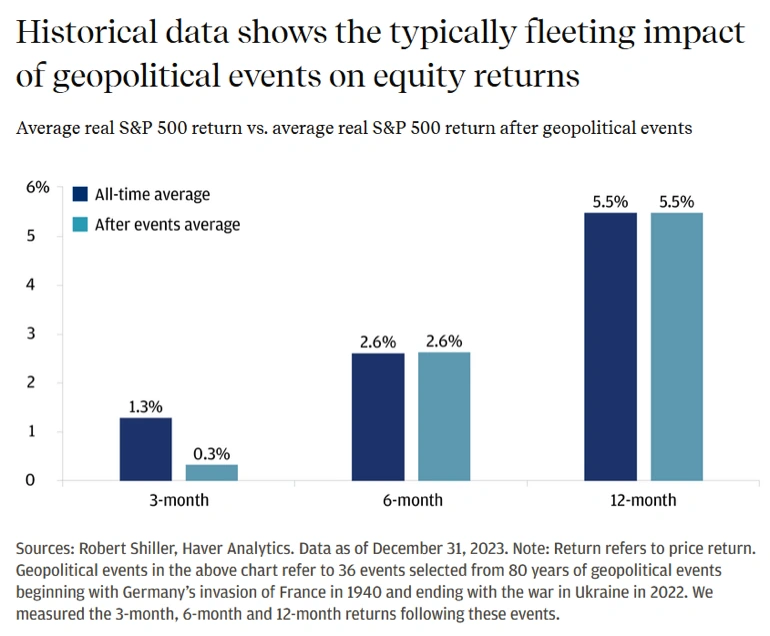
While policy uncertainty may drive volatility, policies will always be more important than politics. Historically, elections and political cycles have had limited impact on long-term equity returns, which are ultimately driven by earnings growth.
Despite bellicose rhetoric and periodic market spasms, transatlantic tensions have not derailed the United States’ productivity-driven expansion. EU-U.S. trade exceeds $1 trillion annually and continues to grow, dwarfing U.S.–China trade volumes. While headlines can always drive volatility, the world remains economically interdependent.
Looking Ahead
We view the overall market backdrop as constructive, supported by economic growth, earnings momentum, AI-driven productivity gains, fiscal support, and improving financial conditions. While there are certainly risks associated with market concentration, we remain optimistic.
Markets aside, America is set to witness its first crewed mission to the Moon in more than fifty years, while the Winter Olympics and FIFA World Cup promise to capture the public’s attention. While the media will always tend to fixate on negative events, it is also important to take a step back to appreciate the positive.